

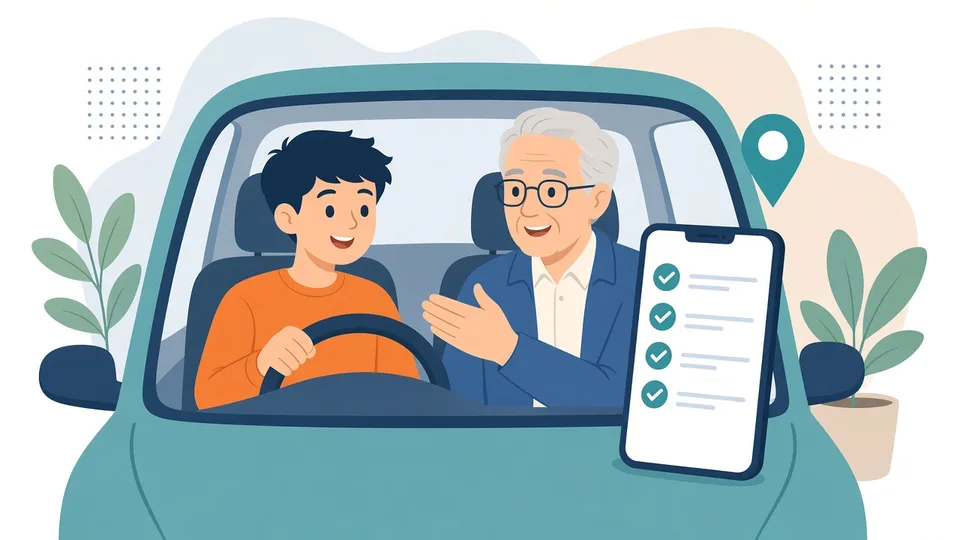
Read to the end and see if a program near you may pay for driving lessons.
Driver’s ed can cost several hundred dollars, and for many families that is the barrier between a permit and a license. A few states and local groups pay for it when you qualify. Here is how these programs work and what to check first.
Free guide · about 4 min read
Check which driver’s ed programs may pay for lessons
Check the programsTapping the button keeps you on this same site.
✔ No sign-up✔ We do not ask for your personal details✔ Independent guide, not a government site
Who these programs are for
They are scholarships or funded classes, and the program pays the driving school directly. Most are aimed at specific groups:
- Young people from low-income households
- Young people in or aging out of foster care
- People who have experienced homelessness or family or dating violence
- Adults in certain food-assistance or job-training programs
Why formal training matters
Drive to Succeed’s own page points to research from the Children’s Hospital of Philadelphia showing a strong link between formal driver training and fewer crashes among new drivers. Drive to Succeed cites that study as the reason the program exists.
That is one reason some states fund training at all. They are not only helping with a cost, but trying to make new drivers safer.
Whether you qualify for a funded course or pay for one yourself, ask the school what the course covers, how many hours of behind-the-wheel time you get and whether it is approved by your state.
Real examples
- Ohio, Drive to Succeed: for Ohio teens aged 15½ to 20 whose families receive SNAP, WIC, Medicaid or Summer EBT.
- Texas, Driver Education Funding Program: run by the Texas Workforce Commission for eligible young people, such as those in foster care.
- Wisconsin, Greater Milwaukee Urban League: free classes for Milwaukee-area adults and income-eligible teens.
Things to know before you apply
- Apply before you pay. Several programs cannot cover a class that is already paid for, including online courses.
- Windows open and close. Some programs accept applications only at certain times, so a program may be closed when you check.
- Applying is free. Ohio warns that people have charged families to fill out the application. Never pay anyone to apply for you.
What happens after you pass
Getting the license is only the first cost. Insurance is usually the next, and it is often the biggest surprise for new drivers.
The National Association of Insurance Commissioners reports a national average of $1,281 per insured vehicle in 2023. That is an average across all drivers, not a quote for a teen.
Car insurance for new drivers
Auto insurance for new drivers tends to cost more because insurers have little driving history to go on. A 2023 Bankrate report estimated that adding a 16-year-old to a married couple’s full-coverage policy added $2,378 a year on average.
Your price depends on age, location, vehicle, record and the coverage you choose. Getting car insurance quotes from several companies before you buy is the simplest way to compare.
Ways to lower the cost
- Ask about discounts: some insurers offer discounts for approved driver training or good grades, and a few states require insurers to offer a discount for certain courses. Rules vary, so ask.
- Choose the car carefully: the vehicle you drive affects the premium.
- Raise your deductible: it can lower the premium, but you pay more if you have a claim.
- Build a clean record: accidents and violations raise costs for years.
The Insurance Information Institute lists more ways to cut auto insurance costs.
Mistakes to avoid
- Paying a school first. Ohio and Texas both say to apply before you pay.
- Using the wrong proof. Ohio, for example, does not accept a photo of an EBT card, only a dated letter from your county office or caseworker.
- Missing the window. Some programs are closed at times, so check the official page before you plan around one.
- Paying a middleman. Applications are free, and no one should charge you to submit one.
Keep copies of every document and every email you send.
Where to start
Check whether your state or city has a funded program, read the eligibility rules and gather your documents. The guide goes through each example program, step by step. The sections above on pay, insurance and financing are general background with linked sources. The guide focuses on the program or test details.
Independent informational content, updated November 23, 2026. This site is not official and is not affiliated with any state agency or program mentioned. We do not sell services or promise approval, funding or results. Rules, fees and deadlines can change: always confirm on the official sources.